Monday, May 11, 2009

MIA

Photo by Fanboy30

Hello fellow bloggers and lurkers!

I'm only writing today's post to let everyone know I'm going to be MIA on my blog after Treatment Tuesday due to the big move. Leaving Wednesday morning! If possible, I'll post from the road, but hopefully I'll be back up and running by next Monday or so.

If you've sent me a character sketch...I'm on them. Just have to move first before I can devote my full attention to them that they deserve. Thanks for your patience!

Your prayers would be appreciated as I pack up and get ready to travel across country with my 15-month old!

Blessings,

Wordle: signature

Friday, May 8, 2009

Compelled to Write, Commanded to Love


I'm having difficulty juggling everything in my life right now. I'm about to embark on another move, one that will be cross-county in stead of cross-town. And this time around, I'll have a 15-month old with me. Whoa. (I know...say a prayer for me, please!)

But ever since I've really taken on writing as a full-time, part-time hobby, my life has changed. Priorities have shifted that maybe shouldn't have. (Okay, probably shouldn't have.) My evenings are spent glued to a laptop screen (and it IS beautiful...as is my backlit keyboard on my new MacBook...but I digress) instead of talking with my hubby. Now that this is to my attention - and I'm so glad it is - I have to do something about it.

Real people first. Characters second.

Of course, Christ is truly first. Perhaps if He hadn't slipped down the priority chain, real people wouldn't have. It's all about keeping your perspective, isn't it? I'm compelled to write. But I'm commanded to love.

It's that simple.

Q4U: Anyone else out there struggling with priorities surrounding your writing, job, family? How are you dealing with it?

Wordle: signature

Thursday, May 7, 2009

Thursday Therapeutic Thought

I was reading the other day about psychotherapist Don Jackson and his contributions to family therapy. His work was mainly in the 1960s during the time of Ozzie and Harriet, which ran from 1952 to 1966 on ABC.

Photo by nickwheeleroz

Ozzie Nelson and his real-life wife, Harriet, epitomized the nuclear American family of the 1950s: bread-winning husband and housekeeping wife. This was the way things were done. Husband came home at five o'clock after a hard day at work to a home-cooked meal, hot on the table. Wife spent her day cleaning and doing laundry and taking care of the children and volunteering. According to Jackson, this is a complementary relationship. Both Ozzie and Harriet were different, but they fit together. One is assertive, the other is submissive. One is emotional, one is logical. (It's important to note that these are not evaluative terms, but just descriptive. And don't assume that one person's position causes the other's. After all, it takes both a sadist AND a masochist to create a sadomasochist relationship!)

Photo by Mrs eNil

The mid-60s was a time of great change in the nuclear American family. Women, spurred on by the civil rights movement, made a movement of their own to join the workforce. Suddenly, women were bringing home paychecks, too, and men came home to dirty laundry and no dinner.
Marriages leaned toward symmetrical relationships where the behaviors of one are mirrored in the other. Both husband and wife have careers and share in household chores and childrearing. Nichols and Schwartz consider the two-paycheck family to be the "most profound change in family life in the second half of the twentieth century" (p. 39).

I think it important to note that research shows neither relationship style is more "functional" than the other, although writing that probably goes against your modern twenty-first century sensibilities!

So how does this affect our writing? We should think about which camp our heroines and heros come from. Think about the possibilities if you had a heroine, expecting the complimentary relationship style of her parents, to meet a hero who presumes his wife is going to work? What are the underlying relational expectations of your main characters (especially relevant if you're writing romance)?


Wordle: signature

Wednesday, May 6, 2009

Mythbuster Research

Photo by kwc

Have you ever been typing along only to discover you've included some element in your book you have no real knowledge of? No personal experience from which to write?

As a member of ACFW, I see lots of emails come across the main email loop asking research questions for works in progress. The subject matter is truly fascinating, some making me want to read the book just because the author asked what grasshoppers taste like. Some questions are mundane things, like whether Jetta remote entries would be operable after being dropped in a water puddle, or which way water swirls down a toilet in which hemisphere (this one really sparked some interest!). These are the nitty gritty details we have to include for realistic portrayals and accurate scenes, but what we're really doing is playing literary Mythbusters.

Did you ever watch that show? Truly unreal, some of the things these guys do...all in the name of busting myths. And we writers have the same dictum: not to include anything someone would even remotely question.

So I'm building my arsenal of contacts to email for different things, like, for example, legal advice. I have a doctor friend I can contact about medicines, I have my own husband for anything I need to know about military life. I guess you could ask, "How many people does it take to write a book?" And the answer is staggering.

Q4U: How many people are in your writing arsenal? Do you have real-life mythbusters who can set you straight about something in your book? Do you email/call your lifelines?

Wordle: signature

Tuesday, May 5, 2009

Treatment Tuesday - Posttraumatic Stress Disorder

First off, I'm a guest blogger over at Seekerville today, so stop in and say hello!

Today’s assessment comes courtesy of Heidi. Her heroine got pregnant when she was 17 and had the baby, but her parents forced her to give the baby up for adoption. She is married, but not to the baby’s father, and has lived over twenty years since the incident mentioned above, which has molded her into the person she is today. She blames her parents for the adoption and doesn’t consider herself at fault (premarital sex and all).

Heidi wants to know the following:

1) If someone has PTSD and they are triggered, would they have “panic attacks” or something that would send them to the hospital for a few days? My character has depression more than PTSD, but I need her to end up in the hospital for a night or two to be monitored—what can she have?
2) What would happen if someone with PTSD tried to regulate their medicine, either by not taking it or taking less or none from time to time?

Great questions to get us started, and I like that you already have a working diagnosis! That can and should serve as the framework for the character.

PTSD—or posttraumatic stress disorder—is an anxiety disorder with a fairly high prevalence (about 8% of adults). It is characterized by reexperiencing an extremely traumatic event accompanied by increased arousal (exaggerated startle response, irritability/angry outbursts, hypervigilance, etc). Yes, if she is triggered, a panic attack would be something she could experience. You’d want to incorporate many of the following symptoms into your portrayal of a panic attack to make it very realistic:

1) Pounding heart, increased heart rate
2) Sweating
3) Shaking or trembling
4) Sensations of shortness of breath/being smothered/choking
5) Chest pain/discomfort
6) Nausea/abdominal distress
7) Faint, lightheaded, dizzy, unsteady
8) Fear of losing control or going crazy or dying
9) Parathesias (numbness or tingling sensations)
10) Chills and hot flushes
11) Derealization (feelings of unreality) and depersonalization (feelings of being detached from oneself)

While any and all of these symptoms would be uncomfortable, scary, and upsetting, likely most people would not end up in a hospital because of a panic attack. (There will always be exceptions, however.) My suggestion is to have her pass out from hyperventilation and she could hit her head on something and then that would require monitoring at a hospital.

People with PTSD also avoid anything associated with their trauma. So Heidi’s character would likely avoid talking about adoption, wouldn’t want to be in a hospital (where I assume she was forced to give the baby up) or an adoption agency. So I’d add a few of these telling type scenes to really up the tension factor when she does have to go to hospital. The reader will know this is a big deal.

But since Heidi mentioned her heroine is also depressed, I would be remiss in pointing out an option that would definitely land her in a hospital for evaluation: suicidal ideation. In California, if a person is deemed by a health care professional to be a risk to themselves or others, they can be checked into a mental hospital for observation for 24-72 hours. You might not want to go this dark route, though.

As for your second question about medications, I’m afraid I can’t help you. I’m a therapist, not a psychiatrist (who can prescribe and advise patients on medication). I would refer a patient who was self-regulating her medications back to the doctor who prescribed the medication. Maybe a medical doctor could help you with the physiological reactions you could incorporate into your book. Sorry I can’t be of more help there, but hopefully I’ve given you some other things to chew on.

This service is for fictional characters only, so any resemblance to real life examples is entirely coincidental. Any other fictional character assessment questions can be directed to charactertherapist@hotmail.com.

Wordle: signature

Monday, May 4, 2009

Garage Sale Writing

Am I the only one who goes through life comparing things to writing? I know for a fact that at least 100 people can compare writing to American Idol (see Rachelle Gardner's blog here). And just Thursday I compared writing to which lane you drive in here.

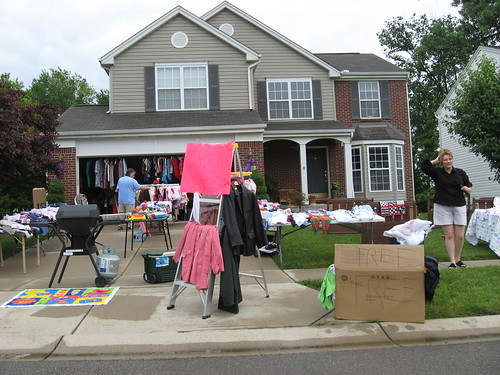
So, in the same vein, I thought I'd talk about garage sale writing. Seeing as how I just had a garage sale this past weekend, it's very fresh in my mind. Various, sundry people come out for garage sales, don't they? Makes for an interesting day and even more interesting conversation later as I analyzed them with my husband. :) These people make interesting subjects, as do the things for sale.

Photo by John Beagle

As I looked on the tables of my so-called "junk," I saw things I once delighted in (i.e., my Vanilla Ice cassette tape - "Ice, Ice Baby" rocked my world.). I saw wedding gifts I never delighted in. I saw books from college I never wanted to read, much less buy and keep. I saw VHS movies I loved in high school. I saw stuff I used while pregnant.

Those tables were full of the stuff of my life. And aren't our novels? I think writing can be like having a mental garage sale. How often do we peruse the shelves of our mind, picking little tidbits here, do-hickies there, as fodder for our books? Are your books just an amalgamation of you?

Wordle: signature

Friday, May 1, 2009

Help! Intervention Needed!

Picture by emdot

I'm almost done with Blessed, but I'm really finding a lot of reluctance in writing this last chapter. I know I'll have lots of revising and cutting and editing to do, so it's not like I'm actually saying goodbye to these characters. But once I finish, there is something so final about it!

Being a therapist, I'm trying to analyze why I have this unwillingness to finish writing Blessed. I know how it's going to end. Every night I tell myself I'm going to finish it, and then I get distracted (purposefully?) playing a widget game on my MacBook, writing a blog post, ANYthing but writing the end of this book!

Likely I need some sort of intervention, since I've been at this juncture for about a week. So I'm asking for writing motivation from this great community of writers! What helps you finish your novels? Why or why don't you have a problem with the end stage of writing the first draft?

Any motivation is appreciated ahead of time! Thanks!

Wordle: signature