Author voice is somewhat of a buzz word in the writing/publishing world, wouldn't you agree? I think (read: hope) I have it, but I have a beef with it. It's this amorphous and perplexing idea that authors are told we need to have but aren't told any path to getting it. (And even worse, some are told it's an ON or OFF switch, not a DIMMER, so if you're OFF, give up writing, 'cause it ain't gonna happen.)
I feel that my voice shows up the most in my dialogue. I'm quippy and fairly quick-witted (I like to think) in person. So I like my dialogue exchanges to be the same. I can reproduce this "voice" while my characters are thinking, as well. Of course, I can't be funny all the time, but those are the scenes I just L O V E to write.
So I'm developing a theory to try to put some structure and form to author "voice." Could it be that YOUR voice shows through the scenes you love to write, too? What's so enjoyable about them? Could it be that, on some level, the scene reflects YOU as a person, YOUR quirks, YOUR temperament, something YOU would respond with?
Wednesday, April 15, 2009
Author Voice
Tuesday, April 14, 2009
Treatment Tuesday - Family Dynamics
Quick thank you to my O-town friends who did a shoutout for me on their blog Plot This. You're awesome!
Today’s assessment focuses on family dynamics. This happens to be one of my favorite topics, seeing as how I’m a Marriage and Family Therapist. We’ll be looking into what is called an enmeshed family system, courtesy of Jean, who wrote in this week.
Jean has a love triangle in her historical novel (don’t we love those!) and didn’t want the reader to feel any conflict at the end of the book with who the heroine ultimately chooses. So her portrayal of the scorned man is key to helping the reader feel satisfaction with the chosen man. Here’s a brief character sketch of Larry, the scorned man.
*Larry* comes from a wealthy background with an overbearing mother and henpecked father. He is adopted, but only finds out at the end of the book that he has a sister. For all intents and purposes, he was raised as an only child. He has witnessed his mother lashing out at his father and vowed never to make her that upset with him. He develops feelings for *Betty* who is not of his class set.
Jean’s ultimate question was this: I have Larry so tied to his mother that he can't break away from her. Do I need a good reason behind this? I want the reader to agree that Betty should tell him to go back to his mother and choose *Ted* to marry.
*Names h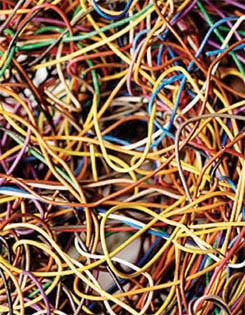 ave been changed to protect the fictional.*
Ah! [rubs hands together] This is a great question, Jean! Thanks for submitting. What we’ve got here in classic enmeshment. This is when individuals/families are too closely intertwined – so much so you can’t see where one ends and the other begins (kind of like the wires in the picture). The therapeutic term for this is “undifferentiated,” coined by Family Systems guru Murray Bowen. “Differentiation” is how capable a person is of being autonomous and individualistic. Where we fall on this continuum is based almost solely on how we were raised.
Larry unfortunately witnessed his parents in arguments that were unhealthy, causing him to form a rigid rule internally that he wasn’t going to do anything to make his mother treat him that way. That rule followed him to adulthood, but in essence, he never grew into a more adult way of interacting with his mother. He’s “fused” with his mother, accepting her word as gospel, never going against her, etc.
Enter Betty. She disrupts the family system by expecting (or hoping, I should say) that Larry will stand up to his mother on her behalf. Larry never does. At this point, I don’t think the reader will think Larry worthy of Betty. It would anger them that he would choose his mother over her. When you introduce Ted – especially if it happens after Larry does the unforgivable deed – the reader will already be smelling romance in the air.
So now the question is how you portray his enmeshment. Enmeshment/fusion can be colorful and humorous or dark and sad. When Larry is asked what he thinks about something, he would likely start his answer with, “My mother always says…blah,blah,blah.” He would always have to consult his mother about any course of action (yes, even romantic ones). He might put up a paltry fight if his mother disagrees with him, but Larry will ultimately cower to her because her approval and blessing mean more to him than they should. This is the crux of the issue which will hinder his forming any strong connection with Betty. I mean, what girl likes to play second fiddle to her mother-in-law? (or anyone else, for that matter?)
So hopefully this helps you with your dilemma, Jean. We want our readers to be satisfied, and a little character therapy can help us give them what they want. You know, I enjoyed this assessment so much I think I’ll continue on the same vein for Thursday’s Therapeutic Thought. Thanks for reading!
This service is for fictional characters only, so any resemblance to real life examples is entirely coincidental. Any other fictional character assessment questions can be directed to charactertherapist@hotmail.com.
Monday, April 13, 2009
Help Me Out!

Thanks to all the well-wishes I got from my announcement about being asked to blog over on Seekerville! I'm hoping to get some help from my fellow writer friends (since you are the population I'm hoping to help with my character therapy) about some questions you might like to see answered about what it is I do. I'm going to explain what a character therapist can do, of course, but surely there must be some other particulars you might want to know? Something that has prevented you from maybe emailing in a question? These are the type of things I want to address in my Seekerville post.
So please help me out and post some questions in the comment section! It would be greatly appreciated!
Saturday, April 11, 2009
Announcement at Seekerville
Check out this post here to see the announcement made at Seekerville! Scroll down to the "Save the Date" portion! It goes without saying that someone's excited!!!
Friday, April 10, 2009
Writing/Reading Tension

How many of you writers out there find it hard to balance your love for reading with your love for writing? (Inherently assumed in this question is that you DO love to read.) Most of you probably have day jobs that aren't writing, which leaves exactly a few hours in the evening (likely when you're trying to cook dinner, spend time with family, etc) for you to wield your craft. So do you alternate nights reading and typing?
When I'm in those precious few hours in the evening, I find myself loath to pick up a book when I have the laptop sitting right there and know I could work on tweaking a chapter or starting a new scene. But here of late, my to-be-read pile has been stacking up higher and higher. So, on the trip to the doctor's, I brought one with me (Linore Rose Burkard's Before the Season Ends - see my Shelfari for more info) to read while waiting to be called.
I was thrilled yesterday to open it and get engrossed in the time period and language or the regency. Regency romances make you wait a bit for the first introduction of the heroine and hero, and I was jonesing for it! When it finally happened, I was so satisfied. It was great to get involved in a book again...it's been a long time since I've had the motivation to do so.
But perhaps one good book was all that was needed to open the floodgates once again. Of course, on the flip side, if a book doesn't grab my attention, I'm not going to read it. I use to be pretty masochistic about this and would read a book regardless because I had paid money for it. But no more. Free time is such a commodity I'm not willing to waste my time!
Q4U: Is this a problem for anyone else? Are you able to read and write as much as you want? If you are reading other books, are you able to turn off your internal editor?
Thursday, April 9, 2009
Thursday Therapeutic Thought

Today, we'll look at the traditional "stages" of grief. Dr. Elizabeth Kubler-Ross was the one to coin these, so I can't take credit. :)
The first traditional stage is Denial. Once the initial shock wears off, the character (or real life person) would pretend they hadn't just been given horrible news. A lot of times, they will just go back to work like nothing happened. This is really just avoidance behavior, trying to put off the inevitable.
The second stage is Anger. Whoever gets in the way here will likely be to blame. This can be explosive like a active volcano or simmering like lava. People will often question, "Why me?" and what they aren't saying is "Why not you?" They will be angry at anyone not affected by their tragedy, angry at God for allowing it to happen, angry at the deceased loved one for dying. Sky's the limit on how this might be manifested.
Third stage is Bargaining. This is when the character might seek ways out of their predicament, often in vain. They might bargain with God, hoping that if they agree to some action, God will reverse what happened. It's important not to write in someone in your manuscript offering the grieving person something they can't fulfill when the character is in this stage. Offering a person false hope during this time would be terrible.
Fourth is the Depression stage, perhaps the stage we most often associate with grief. This is when the character realizes what has happened is irreversible and they turn in to themselves. Anger and Bargaining are fairly animated phases, but depression is despair and hopelessness, an inactive phase of grief. Everything will be globally looked at from this lens.
The fifth stage is Acceptance. This is when the character comes to a place of being able to move forward with their lives despite the loss. This is when terminally ill patients begin making plans for their estate and doing things they have always wanted to do (think about the movie Bucket List).
Application:
I like to think about these phases as on a continuum. People don't always move through them one to the next (as the hurdles in the picture might suggest). Many cross between them or skip one or take two steps forward and one step back ("We go together because opposites attract..." Oh, wait. Got off track here!). Grief is so individualized, making it hard to pinpoint an exact process, so remember that while you're writing.
Good luck to you as you make your character's emotions as real as possible by incorporating some of these grief phases into your manuscript!

Wednesday, April 8, 2009
Romance Christian-Style

For those romance lovers out there...you've GOT to check out this post ("Quick, Dial 911...We're Setting a Fire with Romantic Tension") on The Seekers today! Hot and steamy, but all within the framework of Christian passion! You gotta love that, especially with all the smut out there.
Go check it out...several of us authors "in progress" left little blurbs of romantic scenes that author Julie Lessman commented on, including yours truly.